Forum Reflections: Understanding the Transient Lodging Tax
What role does tourism play in Central Oregon’s economy, and how should the revenue it generates be used to support our community?
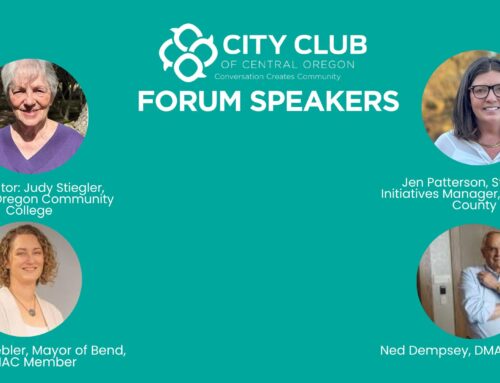
Those questions were at the heart of City Club of Central Oregon’s May forum on the Transient Lodging Tax (TLT), moderated by Cyrus Mooney, Business Development Manager for the City of Bend. Joining him were Bend Mayor Pro Tem Megan Perkins, Deschutes County Commissioner Phil Chang, and Nate Wyeth, Chief of Staff for Visit Bend.
The discussion explored how TLT revenue is generated, where those dollars go, and how recent legislative changes may shape future decisions for local governments.
Tourism’s Economic Impact
Tourism is a major economic driver in Central Oregon. Panelists noted that visitor spending generated more than $400 million in economic activity in Bend over the past year, supporting local businesses, jobs, and tax revenues. Approximately 3,200 people work in Bend’s hospitality sector, and tourism spending helps sustain restaurants, lodging providers, retailers, and recreation-based businesses throughout the region.
Speakers emphasized that tourism often helps stabilize the local economy during periods when resident spending declines. Visitors contribute significantly to Bend’s business activity, helping support jobs and services that residents rely on year-round.
At the same time, panelists acknowledged that visitor activity creates demands on roads, public safety, parks, trails, waste systems, and other community infrastructure. The central question, they noted, is not whether tourism has impacts, but how communities can effectively manage and mitigate them.
Following the TLT Dollars
The forum provided a detailed look at how transient lodging taxes are collected and distributed.
Visitors staying in hotels, resorts, and short-term rentals contribute millions of dollars annually through lodging taxes. In Bend, those revenues support a combination of tourism promotion, public safety, infrastructure, parks, and other municipal services. At the county level, TLT revenues help fund tourism promotion, the Deschutes County Fair & Expo Center, public safety services, environmental health programs, and capital projects.
Panelists highlighted that TLT has become an increasingly important funding source because Oregon’s broader tax structure limits the revenue options available to local governments. As communities continue to grow, TLT provides one of the few flexible revenue tools available to address visitor-related impacts.
The discussion also traced the history of Bend’s lodging tax and how state legislation over the past two decades has shaped the balance between tourism promotion and local government services.
Managing Tourism’s Impact
A recurring theme throughout the conversation was the importance of investing tourism-generated revenue back into the places that make Central Oregon attractive in the first place.
Examples included riverbank restoration projects, trail improvements, visitor education programs, and sustainability initiatives designed to reduce environmental impacts. Panelists pointed to Bend’s Sustainability Fund and Cultural Tourism Fund as examples of how visitor-generated dollars can be reinvested in projects that benefit both residents and visitors.
The conversation reflected a broader shift occurring in many destination communities—from simply promoting tourism to actively managing and stewarding it.
Commissioner Chang noted that destination stewardship includes not only maintaining natural resources and recreation infrastructure, but also educating visitors about how to responsibly enjoy the region. Programs encouraging visitors to “visit like a local” were highlighted as one example of that effort.
New Flexibility Under HB 4148
Much of the discussion focused on House Bill 4148, legislation passed during Oregon’s 2024 legislative session that gives local jurisdictions additional flexibility in how some TLT revenues may be used.
The law creates opportunities for communities to adjust the balance between tourism promotion and other public priorities. It also introduces the concept of business resiliency grants, though panelists noted that the legislation leaves many questions unanswered about how those grants might be structured and implemented.
Bend City Council has begun discussing how to approach those options. While no immediate changes are planned, council members are considering how future TLT revenues could support priorities such as transportation, public safety, workforce housing, and other community needs.
At the county level, commissioners indicated they are currently inclined to maintain existing funding allocations while continuing to evaluate future opportunities.
Several speakers stressed the importance of planning carefully and collaboratively, recognizing that any shifts in TLT policy involve tradeoffs between community services, tourism promotion, and long-term economic vitality.
Resident Sentiment and Community Priorities
The panel also addressed how residents view tourism today.
Visit Bend has partnered with Oregon State University-Cascades to measure community sentiment toward tourism. According to Wyeth, attitudes have improved significantly since the peak tourism surge experienced during and immediately after the pandemic. Recent survey results suggest that most residents now hold either positive or neutral views of tourism.
Panelists attributed that improvement in part to increased community engagement, greater investment in mitigation projects, and a growing emphasis on destination stewardship rather than simple destination marketing.
Still, questions remain about how tourism revenue can best address local challenges.
Audience members raised thoughtful questions about transparency, housing affordability, workforce needs, health care access, and how future funding decisions should be communicated to the public. Several speakers emphasized the importance of clearly explaining tradeoffs and ensuring residents understand both the costs and benefits associated with various funding options.
The discussion highlighted a reality familiar to many communities across Oregon: residents want high-quality public services, but local governments face significant constraints in how those services can be funded.
Looking Ahead
While opinions differed on specific policy approaches, panelists shared a common understanding that tourism is both an asset and a responsibility.
Visitors contribute substantially to Central Oregon’s economy and help fund services, facilities, and amenities that benefit the broader community. At the same time, growth in visitation requires thoughtful planning, ongoing investment, and honest conversations about priorities.
As local leaders continue evaluating the opportunities created by HB 4148, the conversation around TLT is likely to continue. Questions about housing, infrastructure, public safety, environmental stewardship, and economic development will remain closely connected to how the region manages tourism in the years ahead.
For attendees, the forum offered a deeper understanding of a revenue source that touches far more aspects of community life than many residents realize—and a reminder that decisions about tourism are ultimately decisions about the future of Central Oregon itself.